

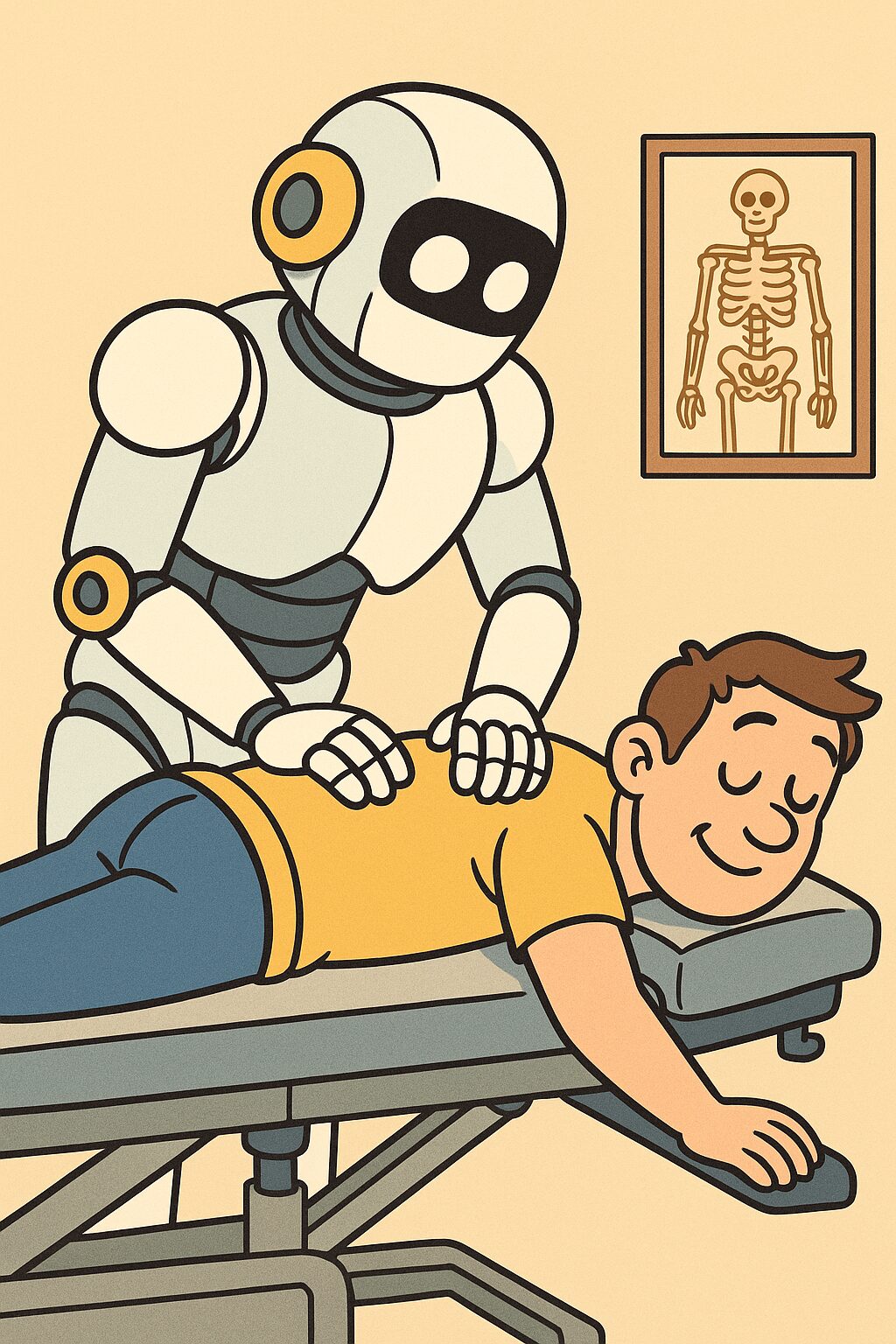

As you chart your path toward a graduate program in a health profession, you’re stepping into one of the most human-centered industries there is. While artificial intelligence (AI) is increasingly playing a big role across many fields—including healthcare—there remain core elements of health professions that AI simply cannot replicate. In fact, the very nature of many healthcare roles makes them uniquely “AI-resistant.” Let’s walk through why that matters for you, how this shapes the future of your profession, and how you can position yourself to thrive in a healthcare landscape where technology supports—but does not replace—the human… namely your hands.
First, it’s worth acknowledging how AI does integrate into healthcare, because understanding its scope helps clarify what it can’t do. AI applications are becoming more common: predictive analytics for disease risk, image-based diagnosis (like radiology or pathology), workflow optimization in hospitals, automated scribes, and more. For example, AI can help flag patterns in massive datasets, suggest options, streamline administrative burdens, and support triage. However—and critically—these tools function as aids, not full replacements. They often require human oversight, interpretation, contextualization, and the personal, ethical, relational work that only a trained clinician can provide.
Why Health Professions Are Hard to Automate
Let’s explore five major reasons why health professions retain a strong human core that AI cannot easily replicate. When a patient is scared, in pain, uncertain, or vulnerable, the human-clinician relationship matters deeply. A chatbot may provide factual information, but it cannot feel or respond with authentic empathy, read non-verbal cues, or hold a hand in a moment of crisis. For instance, a nurse can adjust tone, sense fear, and alter a plan on the fly in a way AI can’t.
Each patient is unique—culturally, emotionally, socially, biologically. AI systems are trained on datasets and algorithms, but they often struggle with the full complexity of human suffering, ethical dilemmas, ambiguous presentations, and changing circumstances. A study found AI matched accuracy for many factual questions, but failed when responses required nuance, empathy or adaptability. Health professionals frequently face decisions involving values, risk, autonomy, end-of-life care, consent, shifting goals of care. AI might suggest options, but cannot substitute for human ethical reasoning, patient advocacy, or shared decision-making that accounts for meaning and dignity.
Hospitals, clinics and field care are unpredictable. A patient may deteriorate suddenly, resources might shift, complex team dynamics emerge, and solutions often require improvisation. Healthcare professionals navigate messy real-world situations; AI is far less capable in unstructured, chaotic, emergent contexts. Healing is not just about medical interventions; it’s about interactions, hope, communication. Patients remember the clinician who listened, who validated their fears, who connected with them as human beings. AI doesn’t build long-term therapeutic relationships, and that relational dimension is central to many health professions.
Health Professions Will be Around for Forever
Given that health professions still demand deeply human skills, there are big implications for how you should prepare and present yourself.In a world of rapid technological change, the health professions stand out as an industry where human connection, empathy, judgment and adaptability will always be required. While AI will continue to reshape how care is delivered, it cannot replace the essential human core of healing and health. For you, as a pre-health student, this is an opportunity. By embracing the human side of care, aligning with technology as a tool, and differentiating yourself through relational competence, you become not only relevant—but indispensable.
As you move forward toward your graduate program, remember: the machines may help us see more, analyze more, work faster. But the person on the other side—the patient, the family, the team—still needs you. And that human dimension? That’s where your future lies.




https://shorturl.fm/Q4FWt
https://shorturl.fm/9uAmK
https://shorturl.fm/NYeXi
Can you be more specific about the content of your article? After reading it, I still have some doubts. Hope you can help me. https://www.binance.com/register?ref=IHJUI7TF
Your article helped me a lot, is there any more related content? Thanks! https://accounts.binance.info/register-person?ref=IXBIAFVY
Your article helped me a lot, is there any more related content? Thanks!
https://shorturl.fm/NC8sI
Your article helped me a lot, is there any more related content? Thanks!
Can you be more specific about the content of your article? After reading it, I still have some doubts. Hope you can help me. https://www.binance.info/fr/register?ref=T7KCZASX
https://shorturl.fm/aKEzK
I don’t think the title of your article matches the content lol. Just kidding, mainly because I had some doubts after reading the article. https://accounts.binance.info/es-MX/register?ref=GJY4VW8W
Can you be more specific about the content of your article? After reading it, I still have some doubts. Hope you can help me. https://www.binance.info/register?ref=IHJUI7TF
Can you be more specific about the content of your article? After reading it, I still have some doubts. Hope you can help me.
Thanks for sharing. I read many of your blog posts, cool, your blog is very good. https://www.binance.com/ph/register?ref=IU36GZC4
I don’t think the title of your article matches the content lol. Just kidding, mainly because I had some doubts after reading the article. https://www.binance.com/register?ref=IHJUI7TF
Oi, judibola828bet, eh? A bit of a gamble, innit? But hey, if you fancy a punt, give it a go! Just remember, gamble responsibly! judibola828bet
Can you be more specific about the content of your article? After reading it, I still have some doubts. Hope you can help me. https://www.binance.com/cs/register?ref=OMM3XK51
https://shorturl.fm/Vodhf
https://shorturl.fm/G9El3
E aí, galera! Comecei a jogar no Egurobetbr e tô curtindo demais! Os jogos são top e o site é super fácil de usar. Se você tá procurando um lugar pra se divertir e tentar a sorte, egurobetbr é a pedida! Bora lá!
https://shorturl.fm/ID3qM
Thank you for your sharing. I am worried that I lack creative ideas. It is your article that makes me full of hope. Thank you. But, I have a question, can you help me? https://accounts.binance.info/register-person?ref=IXBIAFVY
I don’t think the title of your article matches the content lol. Just kidding, mainly because I had some doubts after reading the article.
Your article helped me a lot, is there any more related content? Thanks! https://www.binance.info/fr/register?ref=T7KCZASX
Your point of view caught my eye and was very interesting. Thanks. I have a question for you.
Invite your network, boost your income—sign up for our affiliate program now!
Your article helped me a lot, is there any more related content? Thanks! https://portalesfm.cl/tercer-titulo-al-hilo-santiago-wanderers-se-corona-campeon-de-la-copa-chile-2024/?unapproved=2342&moderation-hash=e0f68fd0e5cb1a3b2feaa06d58c9a556#comment-2342
Your point of view caught my eye and was very interesting. Thanks. I have a question for you.
Your point of view caught my eye and was very interesting. Thanks. I have a question for you.
I don’t think the title of your article matches the content lol. Just kidding, mainly because I had some doubts after reading the article. https://accounts.binance.info/es-MX/register-person?ref=GJY4VW8W
Thank you for your sharing. I am worried that I lack creative ideas. It is your article that makes me full of hope. Thank you. But, I have a question, can you help me?
Your point of view caught my eye and was very interesting. Thanks. I have a question for you. https://accounts.binance.info/da-DK/register-person?ref=V3MG69RO
Sign up and turn your connections into cash—join our affiliate program!
Thank you for your sharing. I am worried that I lack creative ideas. It is your article that makes me full of hope. Thank you. But, I have a question, can you help me? https://accounts.binance.info/ro/register-person?ref=HX1JLA6Z
Join forces with us and profit from every click!
Thank you for your sharing. I am worried that I lack creative ideas. It is your article that makes me full of hope. Thank you. But, I have a question, can you help me? https://accounts.binance.com/si-LK/register?ref=LBF8F65G
Refer friends and colleagues—get paid for every signup!
Boost your profits with our affiliate program—apply today!
Can you be more specific about the content of your article? After reading it, I still have some doubts. Hope you can help me. https://www.binance.info/ar/register?ref=FIHEGIZ8
Maximize your earnings with top-tier offers—apply now!
Can you be more specific about the content of your article? After reading it, I still have some doubts. Hope you can help me.
Thanks for sharing. I read many of your blog posts, cool, your blog is very good.
I don’t think the title of your article matches the content lol. Just kidding, mainly because I had some doubts after reading the article.
I don’t think the title of your article matches the content lol. Just kidding, mainly because I had some doubts after reading the article.
I don’t think the title of your article matches the content lol. Just kidding, mainly because I had some doubts after reading the article. https://www.binance.info/de-CH/register?ref=W0BCQMF1
Your point of view caught my eye and was very interesting. Thanks. I have a question for you. https://www.binance.com/bn/register?ref=WTOZ531Y
Your point of view caught my eye and was very interesting. Thanks. I have a question for you.
Thank you for your sharing. I am worried that I lack creative ideas. It is your article that makes me full of hope. Thank you. But, I have a question, can you help me?
Can you be more specific about the content of your article? After reading it, I still have some doubts. Hope you can help me. https://accounts.binance.com/en-ZA/register-person?ref=B4EPR6J0
Your article helped me a lot, is there any more related content? Thanks!
I don’t think the title of your article matches the content lol. Just kidding, mainly because I had some doubts after reading the article. https://www.binance.info/register?ref=IXBIAFVY
Your article helped me a lot, is there any more related content? Thanks!
Join our affiliate community and earn more—register now!
Thank you for your sharing. I am worried that I lack creative ideas. It is your article that makes me full of hope. Thank you. But, I have a question, can you help me? https://accounts.binance.com/fr/register-person?ref=T7KCZASX
Your point of view caught my eye and was very interesting. Thanks. I have a question for you.
Thanks for sharing. I read many of your blog posts, cool, your blog is very good.